
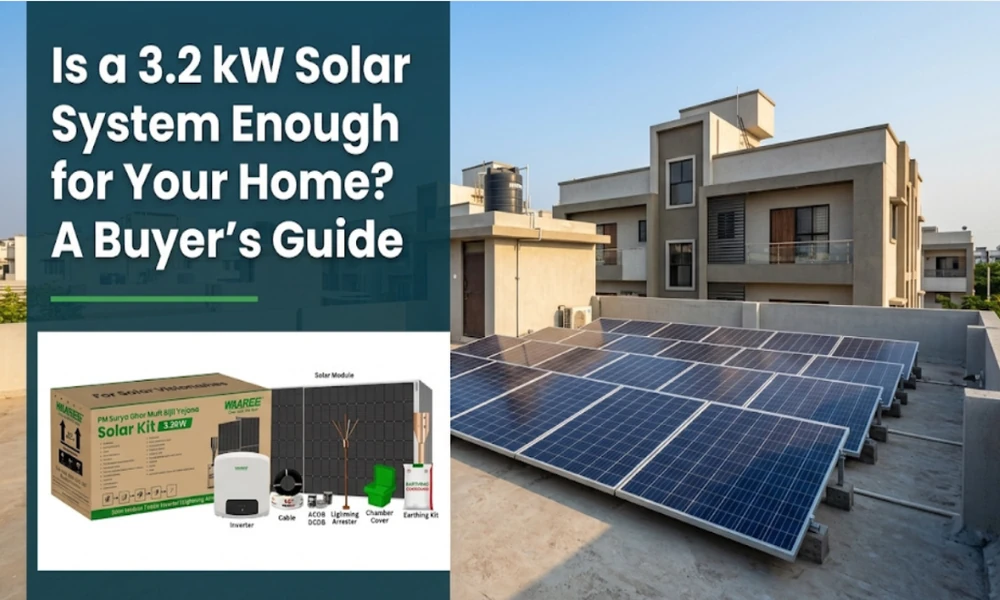

Choosing the right solar system size depends on your electricity consumption, available roof space, and budget. A 3.2 kW residential solar system can be a suitable option for many Indian households, but it is important to understand what it can generate and whether it meets your needs.
How much electricity does 3.2 kW produce?
For most regions in India, 4 to 4.5 units per day are produced by 1 kW solar energy plant. This means that the 3.2 kW system will produce 13 to 14 units per day or 400 units per month. The production of electricity is lower during the monsoons and higher during the dry period, so you may consider 400 units per year on an average basis.
Match it with your actual usage
The best way to do so is from your electricity bills. Get the last 12 bills and see how many units you use rather than the cost in rupees.
A small family living in a 1 or 2 BHK with usage of around 150 to 250 units will feel that 3.2 kW is more than sufficient and might even end up with surplus units for exporting. A family living in a 3 BHK with two or three air conditioners, a geyser, and a washing machine generally comes to 300 to 400 units, and 3.2 kW is suitable for them.
Will your roof have room?
The rule of thumb dictates at least 100 sqft of shadow-free area per kW; hence, for a 3.2 kW array, we have to provide 320 square feet. Watch out for any water tanks, parapet shading, and shadows cast by adjacent buildings or trees from 10 am to 4 pm. Even shading of one or two panels will reduce the performance of the entire string.
The Significance of the Inverter as much as the Panels
The inverter is an important component of the solar system because it helps convert direct current to alternating current for domestic consumption. Some of the factors to be considered when choosing between the various types of PV inverters include efficiency, warranty, monitoring capability, and availability of services locally.
The Waaree Radiance 3.2 kW Solar System is a combination of a 3 kVA single-phase grid-tied inverter with six 560 Wp N-type bifacial DCR solar modules.
But What About the Cost and Subsidies?
The cost of the rooftop solar power plant will depend upon the cost of its components, installation requirements, and location. In the scheme of PM Surya Ghar Muft Bijli Yojana, eligible families can get a maximum of ₹78,000 in central subsidies for the 3 kW and above capacity systems according to the scheme conditions.
The Waaree Radiance 3.2 kW Solar Power System is included in the list of solar power plants that get subsidies from the government. The total amount depends upon the eligibility criteria and other conditions of the scheme.
Net metering and savings
With net metering, extra units your system produces during the day go back to the grid and get adjusted against your nighttime usage. So even if your home uses 250 units a month, a 3.2 kW system can bring your bill close to the fixed charges. Many households recover their investment in around 4 to 6 years with a subsidy, then enjoy nearly free power for the rest of the system’s life of 25 years or more.
When 3.2 kW may not be enough
Think twice if you plan to buy an electric car, add more air conditioners, or run a home office with heavy equipment in the next few years. It is cheaper to size up now than to add panels later, and you should make sure the inverter you pick can handle a future expansion.
Quick checklist before you decide
Review your previous 12 months of energy units. Determine the shadow-free roof area. Request the inverter brand and warranty in writing. Verify your subsidy eligibility. Go for a recognized manufacturer that provides local service. With all five matching, 3.2 kW seems to be a wise choice.
The bottom line
A 3.2 kW solar kit may work well for many Indian homes using 250-400 units per month, subject to generation and consumption. The Waaree Radiance 3.2 kW Solar System comes with a combination of bifacial N-type solar panels and a grid-tied inverter in one kit, which makes it worth looking into.